About The Order
Our Purpose
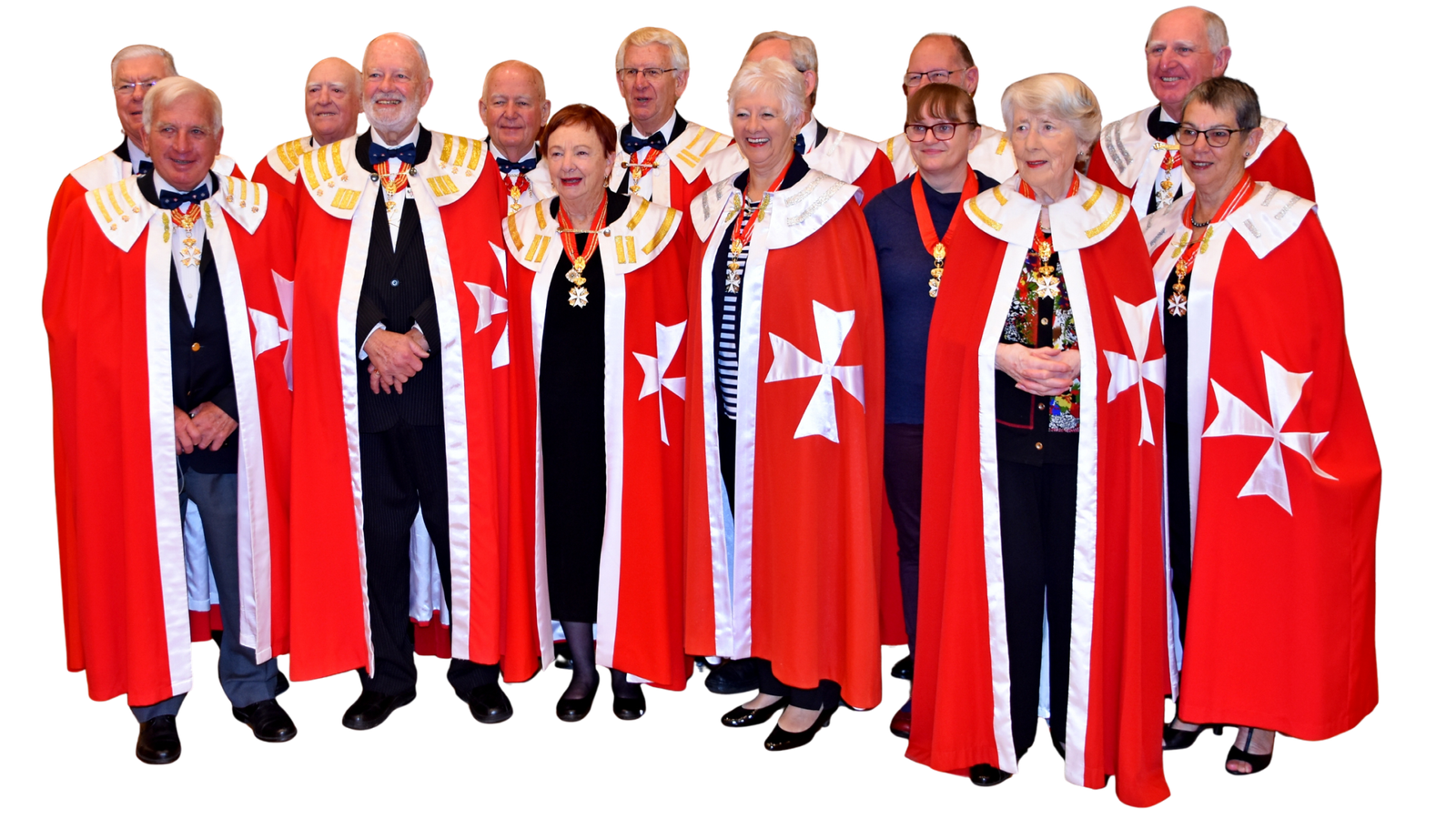
Every nation, every age, and every people call out for the “true knight”—a servant of Christ and the needy; an apostle of good deeds. Theirs is a life of duty and ideals to uphold, now and for centuries to come. Their demeanor is one of uncompromising chivalry and culture. Their voice speaks out for fairness and justice for all. They are living examples of strength of character and personal courage. Blessed is the nation that can boast of having even one such person!
The Order of St. John unites its members in centuries-old fellowship that began eleven centuries ago and, today, continues to promote and encourage the memory of the achievements of its founder, the Blessed Gerard, and the knights and dames who are well-known for their acts of charity and service to humanity.
The Order believes that remembering the service and sacrifice of the men and women who defended the Christian faith and who selflessly served others—regardless of their beliefs—is vital to the preservation of humankind. To achieve this purpose, the founders of the Order originally made membership hereditary, with the expectation that their descendants would feel a special obligation to keep these memories and the institution alive.
In today’s world, proving one’s aristocracy to ten or twelve generations is no longer required for membership and genealogy has been supplanted by one’s humanitarian action and performance. To this end, successive royal and non-royal leaders of the OSJ have provided for a far more ecumenical and democratic organization as well as forward-thinking policies for admission of members who support the Order’s aims:
- The Order is defined as a Christian, Knightly, chivalric, ecumenical, international organization;
- The principal objectives are charity and the defense of the Christian faith;
- True also to its traditions, the Order upholds the ideal of a free world and the rights of men and women as defined in the Universal Declaration of the United Nations;
- It aspires to make a contribution, strictly Christian, to the formation of human and spiritual leadership. The community is made up of persons who are distinguished by their origin, education, upbringing, capacities and worthy deeds; and
- While taking an established and indispensable hierarchy into account, the Order adopts the principle of social equality of all its members.
The Maltese Cross
The Maltese Cross, in the familiar design we now know, made its appearance in the mid 1500s when the Knights were at Malta.
With some exceptions, all portrayals of the Cross of the Order become Maltese, even those portraying earlier figures and events in the Order. This is the beginning of the myth. So how and when was the Maltese Cross introduced into the Order?
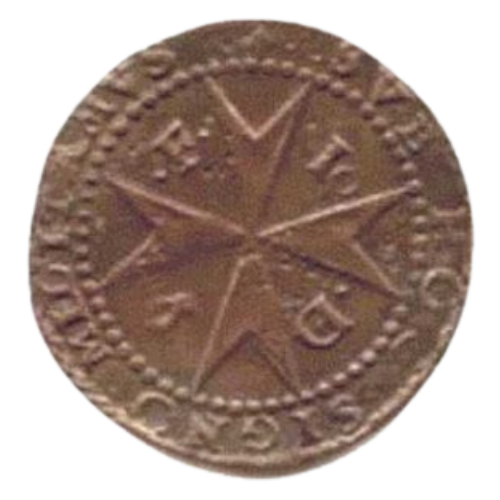
The first evidence of the modern Maltese Cross appears on the 2 Tari and 4 Tari Copper coins of the Grand Master Jean de Vallette-Parisot (Grand Master 1557-1568). The 2 and 4 Tari Copper coins are dated 1567. This provides a date for the introduction of the Maltese Cross into the Order. For a period older forms of the Order’s Cross persisted such as that at the Dutch Commandery of Harderwijk.
In terms of any “time line” for the Order, the introduction of the modern form of the “eight pointed” Cross, with its straight geometrical lines, is post Great Siege of Malta. Fresh architectural input came from the building of Valletta. For example, any visitor to the Co-Cathedral of St John (built between 1573 and 1577) cannot escape the preponderance of examples of the new form of eight pointed cross (today known as the Maltese Cross) throughout the Cathedral.
The chief buildings of the new city, also provide a celebration of the new cross. Researchers may not have to look much further, for the building of Valletta as being the genesis as providing the final form of the evolved cross of the Order.
What is certain is that the Maltese Cross was not adopted by the Order earlier than the mid sixteenth century and thus it can be accepted with historic accuracy that the cross known to be the Maltese Cross was introduced in use to the Order of St. John of Jerusalem during their time in Malta.
In the 15th century, the eight points of the four arms of the later called Maltese Cross represented the eight lands of origin, or Langues of the Knights Hospitaller: Auvergne, Provence, France, Aragon, Castille and Portugal, Italy, Baviere (Germany), and England (with Scotland and Ireland).
The four arms of the Cross represent the four cardinal virtues namely:
1. Prudence
2. Justice
3. Fortitude
4. Temperance
The eight points also symbolize the eight obligations or aspirations of the knights:
- to live in truth
- to have faith
- to repent one’s sins
- to give proof of humility
- to love justice
- to be merciful
- to be sincere and wholehearted
- to endure persecution
The Order teaches that the eight points of the cross represent the eight Beatitudes:
Blessed are the poor in spirit, for theirs is the kingdom of heaven.
Blessed are they who mourn, for they shall be comforted.
Blessed are the meek, for they shall inherit the earth.
Blessed are they who hunger and thirst for righteousness, for they shall be satisfied.
Blessed are the merciful, for they shall obtain mercy.
Blessed are the pure of heart, for they shall see God.
Blessed are the peacemakers, for they shall be called children of God.
Blessed are they who are persecuted for the sake of righteousness, for theirs is the kingdom of heaven.”
Banners
Structure

If you’re interested, you can discover the structure of the Order of St John of Jerusalem, Knights Hospitaller
OSJ (Malta)